- calendar_today August 17, 2025
Everything to Know About Marvel’s Retro-Style Fantastic Four Movie
Marvel’s The Fantastic Four: First Steps is a gorgeous, highly nostalgic look at one of its earliest superhero teams, full of solid performances (particularly from Pedro Pascal and Ebon Moss-Bachrach), and dripping with 1960s-inspired flair. It’s a treat for the eyes, a journey for the ears (the soundtrack is pure yacht-rock radio), and a cakewalk for the brain. But for all of its style and old-school affection, the film never quite amps up the suspense or stakes to make a lasting impression.
Marvel producer Kevin Feige was not exaggerating when he dubbed the movie “a no-homework-required” experience. In a cinematic universe that has become increasingly dense, exhausting, and demanding of your attention and prior knowledge, it’s nice to encounter a Marvel movie that doesn’t require at least one degree in quantum physics to keep up with all the multiverses, meta-cameos, and spin-offs.
As a stand-alone film, First Steps reintroduces Reed Richards, Sue Storm, Johnny Storm, and Ben Grimm without getting too bogged down in the continuity or connections of past adaptations. The movie is happy to start from square one, and sometimes, it leans into that a bit too much.
Four years earlier, the quartet was on a cosmic space mission when their ship was hit by radiation, which affected each member’s DNA differently. Reed (thoughtfully and humorously played by Pedro Pascal) acquired the power to stretch and deform his body like taffy. Vanessa Kirby’s Sue Storm can now turn invisible and push out force fields from her hands. Joseph Quinn’s Johnny Storm can now turn his body into flame and fly. Ebon Moss-Bachrach’s Ben Grimm now appears permanently as The Thing: a huge, rock-covered giant with superhuman strength.
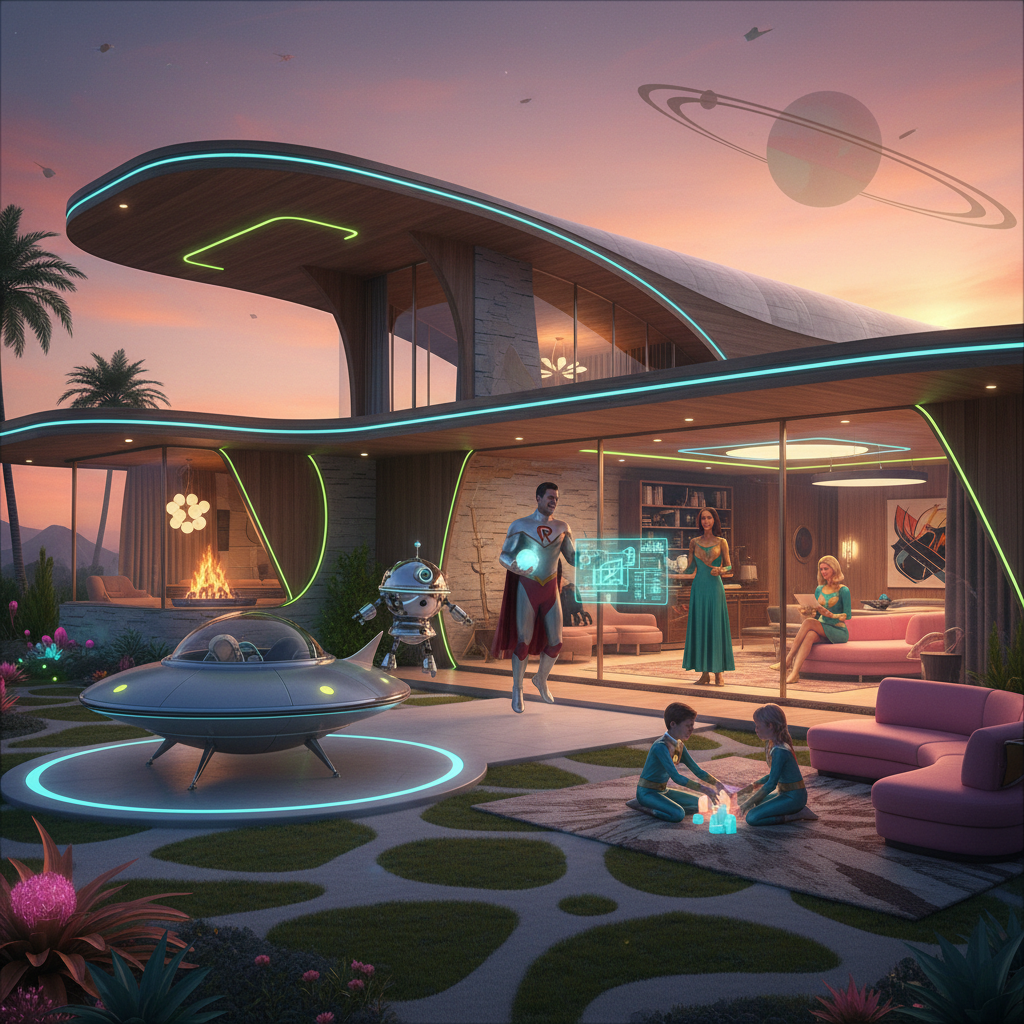
The group now lives together in what looks like a Mid-century modern version of an outer space compound. They have flying cars, chalkboard equations decorating their kitchen walls, and even a toddler-sized robot named H.E.R.B.I.E. running errands for them. The First Steps world is 100% retro-futurism: boxy television screens, no cell phones, and relentlessly optimistic in its set design. Imagine if The Jetsons and Lost in Space got mugged by a Marvel comic book.
The sense of style runs through the movie, but the narrative often feels stuck in low gear. One of the dominant themes of the film is the family nature of the Fantastic Four. The four leads have a very close bond, and there’s a lot of sibling-style banter and ribbing that functions both as comic relief and to emphasize how comfortable they are with each other. Sue reveals early in the film that she’s pregnant, and Reed’s initial anxiety is relatable (if not always pleasant to witness). In one of the film’s best sequences, H.E.R.B.I.E. is ordered to run a full child-proofing operation of their house—and also their science lab.
Johnny and Ben, in particular, serve as the petulant siblings of the equation, providing the pratfalls and bickering while also very obviously enjoying the idea of being prospective uncles. It’s both the film’s strength and weakness that even when the “end of the world” comes in the form of a giant, armored cosmic being, these characters are more interested in what their newfound powers can do than in fighting the villain. Much of the chemistry in this foursome bounces off the idea of what they can do to each other, and not so much off of anything outside of the family.
There’s also a distinct lack of oomph to most of the action sequences. The Fantastic Four: First Steps introduces Galactus, a giant, armored, glowing-eyed being on a mission to Earth with a very specific appetite. Before he can land, he sends a herald (Julia Garner, in motion capture) with the bad news. The Silver Surfer makes her entrance as she soars through space, on a slick metallic surfboard that drips with menace. She’s also a source of fascination (and eventual infatuation) for Johnny.
Galactus moves at such a glacial pace, though, that it’s never quite a surprise when a character pulls out of harm’s way at the last second. Likewise, as the heroes chase him through space or try to fend off attacks from the Surfer, the action scenes feel dialed down to better suit the overall retro vibe: slow-motion bursts of light, flame that trails behind the Human Torch, clouds of white smoke for everyone’s big attacks. The film’s climax of Sue going into labor during the space mission and therefore having to return to Earth is more trippy than thrilling. It’s a unique, odd combination: childbirth and planetary destruction intertwined with a color palette that feels like it was dipped in space-age watercolors.
The dichotomy between sincerity and silliness encapsulates the film’s overall tone. The movie has earnest, grounded emotional beats, but the soft, pastel-colored aesthetic soaks them all up before you have a chance to react to any one scene in particular. The film never has much at stake, even when the end of Earth itself is at stake. It’s less adventure film than a children’s storybook.
The Fantastic Four: First Steps is pleasant and well-acted, but ultimately light on action and dramatic weight compared to Marvel’s best entries. The film is fun, accessible, nostalgic, and charmingly heartfelt—but also in a very light way. If you’re in the mood for something less cosmic and world-ending, more retro and whimsical, First Steps may hit all the right notes. If you’re looking for your next Marvel mega-blockbuster, it’ll feel more like a beautifully wrapped gift that’s unexpectedly empty inside.