- calendar_today August 10, 2025
LA’s cabinet of wonder faces fiery challenge.
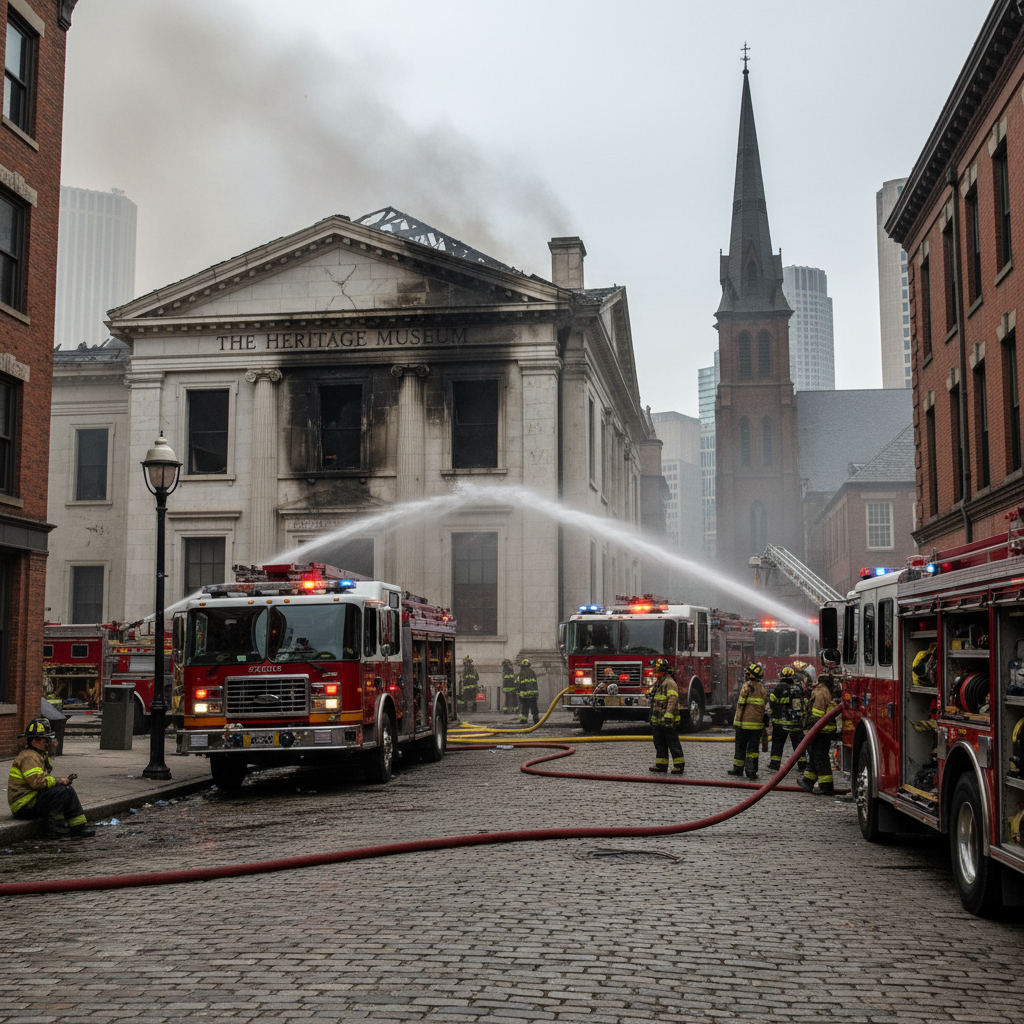
Los Angeles’ beloved Museum of Jurassic Technology is reeling in the wake of a nighttime fire that caused extensive damage to the building earlier this month. The blaze, which started late on July 8, destroyed the museum’s gift shop and caused smoke damage throughout several galleries. The museum is projecting lost revenue of around $75,000 during its closure, and hopes to reopen sometime next month.
Situated in Culver City, the Museum of Jurassic Technology has long been a fixture of LA’s cultural scene. The museum was founded in 1988 by David Hildebrand Wilson and Diana Drake Wilson, and since its opening, it has drawn visitors to its deliberately confusing and sometimes questionable exhibitions. Advertising itself as “dedicated to the advancement of knowledge and the public appreciation of the Lower Jurassic,” the museum has little to do with that geologic period. Rather, it is influenced by Renaissance-era cabinets of curiosity, also known as wunderkammers, early versions of the modern museum.
Over the past three decades, the MJT has established a reputation for itself with its multi-layered and at times inscrutable approach to narrative. The exhibitions present a mix of authentic historical artifacts, alongside fiction and factual information in a way that many visitors cannot distinguish what is true and what is false. For instance, one of the museum’s permanent galleries is a tribute to the work of Athanasius Kircher, a 17th-century Italian polymath and Jesuit priest. Another feature is the ultra-miniature sculptures of Armenian artist Hagop Sandaldjian, which are displayed inside the eye of a needle and sculpted out of a single human hair.
Elsewhere, the museum takes a more farcical approach to historical narrative. A decomposing collection of dice, which once belonged to magician Ricky Jay, occupies its room. A display called “The Garden of Eden on Wheels” is a visual survey of Los Angeles-area trailer parks. Visitors can also view stereographic radiographs of flowers, microscopic mosaics made from butterfly wing scales, and a strange collection of letters written by amateur astronomers to the Mount Wilson Observatory between 1915 and 1935. In 2005, the museum added a Russian tea room, modeled on the study of Tsar Nicholas II at St. Petersburg’s Winter Palace.
Firefight and Aftermath
The Chronicle reports that writer Lawrence Weschler, whose 1996 book Mr. Wilson’s Cabinet of Wonder delves into the origins of many of the MJT’s objects, published a long account of the museum’s fire. In his telling, the fire was first noticed by David Wilson, who lives in a residence just behind the museum. Wilson saw flames coming from the building and ran to the museum, carrying two fire extinguishers. “It was a ferocious column of flame,” Wilson later described the inferno, adding that the blaze was climbing up the corner of the wall closest to the street.
The two extinguishers, however, were insufficient to put out the growing fire. Luckily, Wilson’s daughter and son-in-law arrived shortly after, carrying a larger extinguisher. The couple managed to extinguish the blaze before firefighters arrived. The firefighters, the Los Angeles Times reports, later told Wilson that they would have been unable to save the museum if they had arrived one minute later.
Smoke from the fire spread through many of the museum’s galleries. While the gift shop appears to have sustained the bulk of the structural damage, the smoke appears to have permeated much of the museum’s space. Wilson described the smoke damage as a “thin creamy brown liquid … evenly poured over all the surfaces—the walls, the vitrines, the ceiling, the carpets, and eyepieces, everything.” Smoke infiltration is difficult to manage, and all the more so in a space that is as invested in presentation as the MJT. Volunteers and museum staff have reportedly been working around the clock to clean and restore the museum, a process which has been slow and arduous.
In the meantime, Weschler has encouraged those who support the MJT to donate to the institution’s general fund to help with repair costs. Weschler made clear that the MJT is “one of the most truly sublime institutions in the country” and a place that does not neatly fit into the categories of science, art, and narrative as we traditionally understand them.
No official reopening date has been set for the museum, but there is optimism that it will reopen to the public at some point next month in all its satirical, scholarly, and surreal glory.