- calendar_today August 7, 2025
Rising Costs Could Push Board Games Out of Reach for Many
The board game industry, which prides itself on being creative, close-knit, and not all that profitable, has recently received an economic gut punch that some worry could put its future in jeopardy. Last week, designer Jamey Stegmaier, known for successful games like Scythe and Wingspan, expressed his disappointment this week at the recent announcement of a 54 percent tax on goods produced in China and imported to the U.S.
In a now widely-circulated post on his blog, Stegmaier shared that “Last night I tried to work on a new game I’m brainstorming, but it’s tough to work on the future when that future looks so grim. I mostly just found myself staring blankly at the enormity of the newly announced 54 percent tariff.” Stegmaier is an A-list designer responsible for some of the world’s bestselling board games, so it was unusually raw for a statement coming from an industry heavy hitter— and it also seemed to sum up a feeling that was shared across the industry.
Chinese Manufacturing Is a Standard Business Model
The fact of the matter is that the American board game industry is heavily dependent on Chinese manufacturing. Yes, other countries like Germany also have facilities that produce board games—Germany is the spiritual center of modern tabletop gaming, if you will—but most publishers flock to China for a “full service” deal, one that provides the maximum level of specialization in everything from printed cards to custom plastic miniatures, wooden tokens, die-cut boards, specialty dice, and more.
The equipment, labor, materials, and expertise to replicate all that exists domestically in theory, but it is not practically possible. Stegmaier himself said he was once quoted $10 by a U.S.-based manufacturer, just to produce a basic, empty game box. For that same $10, he could produce and package an entire game in China.
Which is why this new tariff hits so hard. Profit margins in the board game industry, especially for small and mid-sized publishers, are famously small. Game design is treated more like a labor of love than a path to riches, and that is part of what makes this such a sweeping upheaval for the community. Publishers did not get a chance to even price things out with their manufacturers; the tariff went into effect immediately.
Publishers Frustrated and Concerned
Meredith Placko, CEO of long-time publisher Steve Jackson Games, recently made a statement in agreement with Stegmaier’s. Her company, which produces the popular card game Munchkin, among other games, is no stranger to manufacturing abroad for all of the same reasons most American publishers do.
“Some people ask, ‘Why not manufacture in the US?’ I wish we could,” Placko wrote in her post. “But the infrastructure to support full-scale boardgame production—specialty dice making, die-cutting, custom plastic and wood components—doesn’t meaningfully exist here yet. I’ve gotten quotes. I’ve talked to factories. Even when the willingness is there, the equipment, labor, and timelines simply aren’t.”
For Placko, who founded the company with her husband in the 1980s, this isn’t a question of changing production facilities. It’s a way of life coming to an end. As she put it in an update: “This isn’t just a policy change. This is a seismic shift in our industry.”
Rob Daviau, co-founder of Restoration Games and the designer of such games as Pandemic Legacy, has also been sounding the alarm, vocally on social media and in interviews with news outlets. He’s been talking to several reporters, including one from BoardGameWire, who wrote that Daviau was “forecasting a great collapse in the hobby gaming market in the US if ever this kind of thing was enacted.”
Gamers Will Feel the Pain, Too
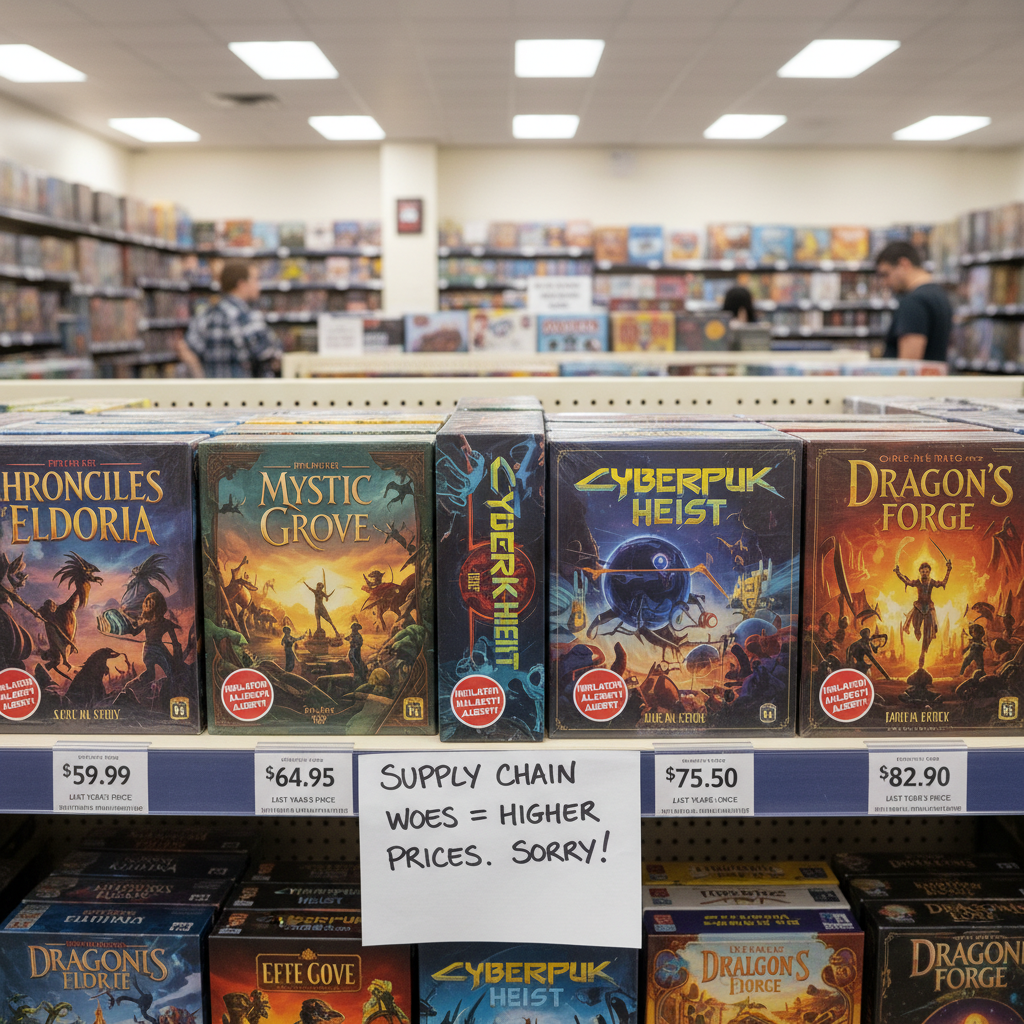
The biggest concern is obviously for publishers and designers, but the ramifications are also expected to trickle down to gamers in the coming months and years. In short, most new games will simply cost more to purchase. Some publishers may try to recoup costs by short-changing production on some or most materials, resulting in a lower-quality product but the same sticker price. Others may scale back new releases or publish fewer altogether.
Retailers, many of whom are already fighting an uphill battle in an era of online shopping, are also in danger. If gamers stick to their collections—which in many cases could include unplayed games from years past that they may refer to on social media as their “shelves of shame” —or shop online for better prices, brick-and-mortar stores could stand to lose.
“There will be a rush to the exits in the coming months,” Stegmaier said. Within a few months, US companies will lose a lot of money and/or go out of business. And US citizens will suffer from extreme inflation.”
Workarounds Are Limited, Exasperation High
Publishers with deep pockets may be able to skirt tariffs for now by shipping goods to a non-U.S. distributor and then rerouting them through a European market (Europe, for one, is not as affected). That’s a workaround, sure, but not a real solution for American companies with smaller inventories.
Worse, many publishers were caught with projects already underway, with games fully printed and in boxes before the announcement. For those games that were printed, it is too late to change course. “We can try to rearrange our budgets” for future games, Stegmaier said, “but it’s a wash for the games we had printed before the tariff was announced.”
As for the companies stuck with games still in the pipeline, they will be forced to eat the cost. “I have 8,000 games leaving a factory in China this week and now need to scramble to cover the import bill,” Chris Solis, head of California-based Solis Game Studio, wrote on social media. “Welcome to the new normal. Or hell. Who knows?”
Industry Advocacy and Government Inaction
The Game Manufacturers Association, or GAMA, an advocacy group for board game publishers, has taken an active role in voicing its concerns to the government. They have been in contact with USTR, which released the new tariff list, and GAMA has advocated to get them to remove or at least reduce the 54 percent figure, so far to no avail.
Game designers have also offered a different solution to the “problem,” one which has the unintended consequence of showing just how thoroughly the new tariff will affect all elements of the hobby game world: just don’t buy new games for a while.
Games from Games! The Gold Anthology, a Kickstarter anthology about board games that was canceled before it could be released, has been put on sale for half price. Since it’s a collection of full-size games, aseveralwhich are top designers who have included new print-and-play versions of their games in the collection, you could do a lot worse if you’re thinking of “investing” in the board game world. (Buy from your local game store if you can, of course!)