- calendar_today August 12, 2025
How Canada’s Biggest Economic Hub is Coping with Trade Shocks and Uncertainty
Introduction
Toronto Metro, the economic lifeblood of Canada and seat of the country’s financial hub, is struggling to contain the widespread effects of ex-U.S. President Donald Trump’s trade measures. Although several years have gone by since Trump’s first round of tariff threats, the effects still influence Toronto’s manufacturing industry, financial investment, retail market, and real estate construction.
As the possibility of Trump’s political comeback creates new uncertainty in international markets, Toronto industries are preparing for new trade tensions. Protectionism from the U.S., threats of tariffs, and readjustments of free trade agreements like USMCA (United States–Mexico–Canada Agreement) have all produced an uncertain economic landscape, forcing Toronto’s industries to re-strategize in an increasingly uncertain global marketplace.
Manufacturing Feels the Pressure
Toronto’s large base of manufacturing — automotive, aerospace, and heavy machinery — has been hit directly by the spillover effects of U.S. trade policy changes. Tariffs placed on Canadian steel and aluminum and broken supply chains have had a staggering effect on costs and brought about delivery delays.
Increased Costs of Raw Materials
Trump’s 2018 tariffs on Canadian steel and aluminum caused shockwaves in the manufacturing system of Ontario. Manufacturers, with Toronto in its hub, now have to contend with higher material costs, pinching already-slim margins. The automotive and machinery industries, which depend extensively on such metals, are among the most affected.
Supply Chain Disruptions
Sophisticated, cross-border supply chains previously functioning with ease have been disrupted by new customs restrictions, delays in shipments, and increased freight prices. Such hurdles are most difficult for manufacturing operations with just-in-time requirements, which are intolerant of even small delays.
Export Barriers and Regulatory Uncertainty
Trump’s preference for bilateral trade agreements with other countries, as opposed to multilateral cooperation, cast a cloud of uncertainty. Abrupt changes in U.S. policy have made it hard for Toronto manufacturers to make plans to export confidently or obtain long-term U.S. contracts.
To react, Toronto manufacturers are diversifying their supplier pools, investing in inventory control systems, and pursuing non-U.S. export markets — including the EU and Asia — to protect their business operations from the volatility of geopolitics.
Financial Sector Responds to Market Volatility
Toronto is Canada’s financial hub, home to large institutions such as the Toronto Stock Exchange (TSX), Canada’s “Big Five” banks, and various investment and asset management companies. These institutions have not been spared from the volatility caused by Trump’s trade wars.
Stock Market Fluctuations
Trade tensions with China, Mexico, and Canada created market volatility, which continues to shake investor confidence. Toronto’s financial experts have been working overtime to update forecasts and risk models in response to constantly changing trade developments.
Currency Instability
The Canadian dollar has fluctuated on reaction to U.S. policy announcements. A falling loonie can spur exports, but at the same time raise import prices, and so economic planning becomes a balancing act for business and financial planners alike.
Interest Rate Sensitivity
Canadian and foreign central banks have had to tread through these uncertainties carefully. Toronto-based financial institutions are watching interest rate movements closely as they relate to inflation, economic expansion, and borrowing patterns. Numerous ones are recommending clients hedge against extended volatility.
Despite these challenges, the industry remains optimistic. Financial institutions are diversifying their portfolios, broadening fintech investments, and creating contingency plans for potential disruption from any future change in U.S. policy.
Consumers and Retailers Experience Price Increases
Toronto Metro, too, with its vibrant shopping streets and huge multicultural consumer market, has started to feel the pinch. Trade policy impacts have filtered down to the shelves of stores and the household budget.
Increased Prices on Imported Products
Tariffs on imported products such as electronics, clothing, and domestic appliances have caused tangible price increases. Retailers are faced with a dilemma: charge consumers or eat the costs and face losses in profit margins.
Declining Consumer Expenditure
Due to inflation and rising living expenses, most Torontonians are reducing spending on discretionary purchases. Retailers are noticing a rise in demand for affordable and local options, while high-end goods and high-end services are experiencing declining sales.
E-commerce and Behavioral Shifts
Toronto consumers are shifting rapidly. Consumers are using online platforms, direct-to-manufacturer, or subscription services to save money. Retailers are also adopting AI-powered inventory and price systems to be responsive.
Though facing challenges, Toronto’s retail industry is exhibiting tremendous resilience. Numerous businesses are accessing local supply, adopting digitalization, and testing innovative marketing strategies to retain consumer interest amidst a changing scenario.
Real Estate and Construction Face Increasing Costs
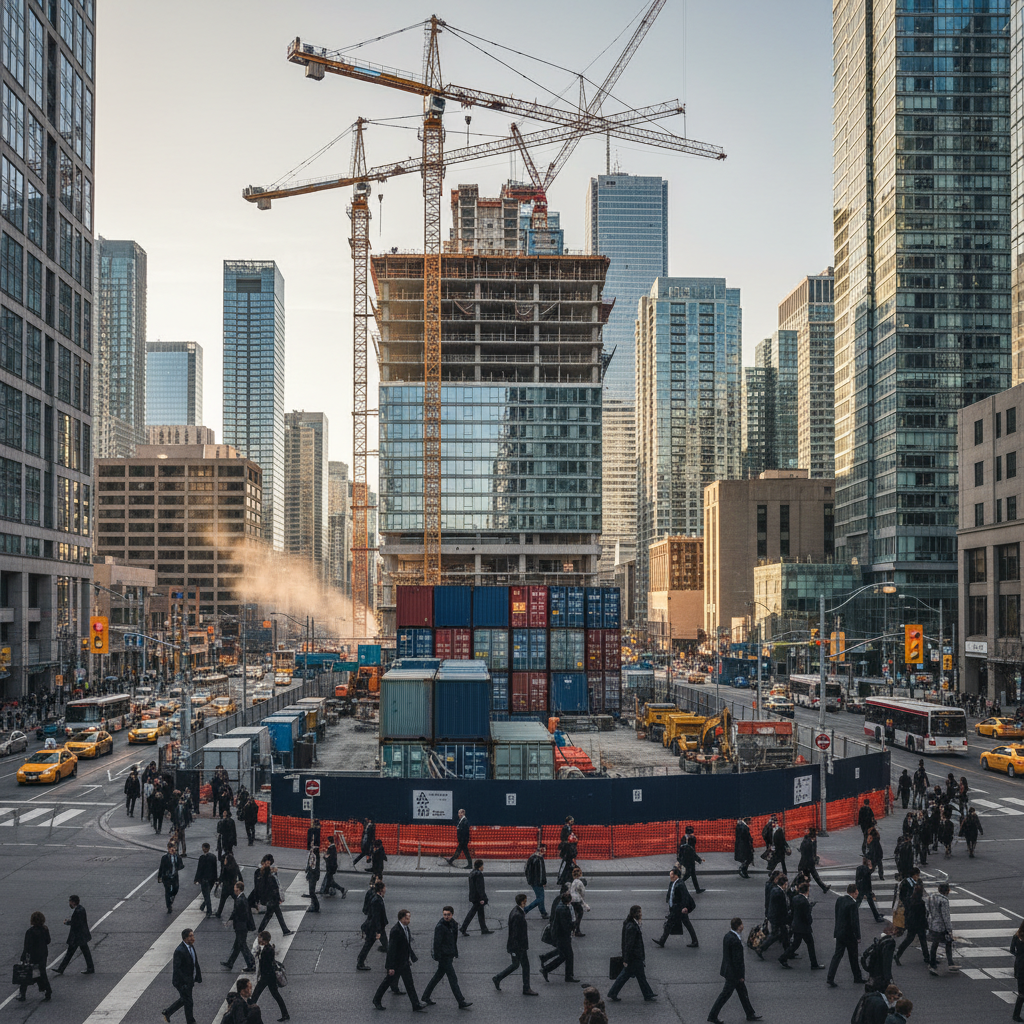
The impacts of trade policy are also rippling through Toronto’s construction and real estate sectors. From skyscrapers to suburban projects, developers are grappling with higher costs and market uncertainty.
Increased Construction Costs
Tariffs on foreign materials like steel, aluminum, and machinery have substantially increased construction costs. For developers, these added costs can translate into reduced profit margins or project delays.
Investor Caution and Market Uncertainty
Real estate investors are becoming more conservative as world trade tensions jeopardize economic stability. Commercial real estate, particularly downtown Toronto, is seeing more conservative investment trends because of fears over volatility in foreign investment.
Changes in Housing Demand
Affordability is still an issue in Toronto’s housing market. With construction prices increasing, new developments are getting more expensive — making it even more difficult to afford for first-time homebuyers and newcomers.
Nevertheless, Toronto’s real estate market is still holding strong. Developers are turning to modular construction, green building products, and urban densification tactics to keep costs under control and meet demand. Long-term urban growth forecasts are still positive.
Toronto’s Economic Outlook: Resilience in the Face of Global Trade Shocks
Although Trump’s trade policies have certainly sent economic waves through Toronto Metro, the region is coming back with characteristic strength. The city’s global economy, skilled talent, and international connectivity are serving as vital resources in navigating global trade turbulence.
Companies are finding new trade relationships in Europe, Latin America, and the Asia-Pacific to minimize reliance on the U.S.
Innovation in supply chain management, financial technology, and green construction is enabling Toronto to evolve and adapt.
Public-private partnerships are increasing as industries demand targeted support, strategic investments, and diversification of trade strategies.
Conclusion
Trump’s trade policies have shaken up global markets, and Toronto — as Canada’s economic powerhouse — has been squarely in the crosshairs. However, despite increased material costs, unstable markets, and uncertain export dynamics, the city is moving forward.