- calendar_today August 14, 2025
.
Electric vehicle (EV) sales and market share have experienced significant slowdowns in the United States recently. EVs in the US suffered their first sales decline in August after more than a year of month-over-month increases. Automakers like Genesis and Volvo have already encountered customers refusing to buy their EV models, with the companies taking steps to pull back on electric offerings.
Faced with reduced subsidies and federal rollbacks on vehicle pollution standards, EV purchase decisions are looking increasingly unclear. According to industry analysts, the most critical factor in US households may not be federal policy, but what is already in people’s garages.
It’s Where You Charge
Consumer surveys have long shown that charging access and anxiety remain the number one reason not to switch to electric. A recent market research report from Telemetry Vice President Sam Abuelsamid explores this challenge, highlighting a key contributor: garage use.
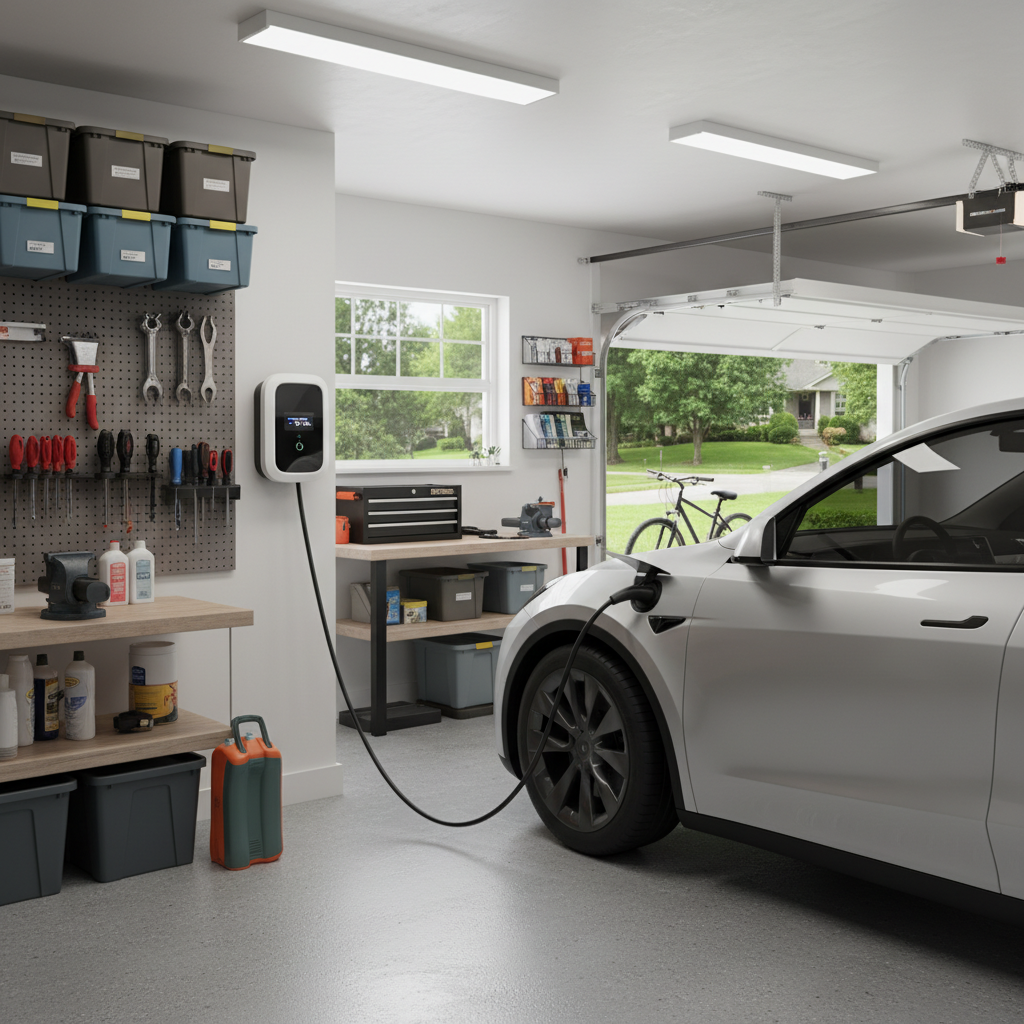
Despite all the attention to fast-charging network expansion, the majority of EV charging is still done at home. Abuelsamid’s research, and data from the National Renewable Energy Laboratory (NREL), show that AC home charging represents as much as 80 percent of all EV charging, with a single-family home being the most common destination. The NREL study found 42 percent of homeowners could plug their vehicles into a level 2 (240-volt) charger right now, based on proximity to an outlet at the home.
The potential for charging with a garage or near-home outlet increases to 68 percent if Americans parked in those areas instead of using garages as storage spaces. Abuelsamid estimates “90 percent of all houses can add a 240 V outlet near where cars could be parked. Parking behavior, namely whether homeowners use a private garage for parking or storage, will likely become a key factor in EV adoption.”
Parking behavior is an underappreciated piece of the puzzle. If more homeowners parked in their garages rather than using them for storage, the number of households that could support an EV charger would rise from 31 million to over 50 million. That number could climb above 72 million when considering homes where adding new wiring would be possible.
It would far outstrip Telemetry’s EV forecast for 2035 of between 33 million and 57 million vehicles. But while homes may have theoretical capacity for EVs, that does not necessarily mean they are ready to support a vehicle. NREL data also indicates almost 34 million homes would need an electrical system upgrade to use a level 2 charger, which requires at least 30 amps of power. In some cases, homeowners could face several thousand dollars in costs for wiring new chargers and making electrical panel replacements.
Not only is it a financial burden on customers, but it also challenges one of the primary value propositions of EVs: long-term cost savings. Adding in the cost of home charging installation reduces or even negates cost-of-ownership benefits over internal combustion engine (ICE) vehicles.
The Apartment Housing Challenge
All of the garage and charger dynamics are even more complex for the 23 percent of Americans who do not live in single-family homes. Apartment dwellers, condo owners, and townhouse residents generally do not have the authority to make home charger installations themselves. Instead, they must seek approval from landlords, building management, or co-op boards.
The process is not only more complex but also more expensive. An owner of an apartment co-op may need to spend up to $2 million for a panel upgrade before two shared level 2 chargers can even be installed. Wiring a charger several hundred feet away from a parking space also increases the cost.
The private nature of these dwellings makes them less likely to receive municipal or utility incentives or tax breaks for installation. Approximately 1 million EV owners currently live in multifamily housing, according to Telemetry. Of these, 11 percent of EVs are parked near an outlet suitable for charging.
States are mandating that new construction multi-family complexes offer charging to 20–25 percent of their parking spots, Telemetry reports. Still, by 2035 the number of EV charging-capable spaces in multi-family homes is likely only between 6.7 million and 11.4 million. It is well below analysts’ estimated demand.
Public Charging Infrastructure
This all points to significant public charging demand from US EV owners. Telemetry forecasts that between 11.7 million and 14.3 million EV drivers that live in houses will still require public charging in 2035. Another 7.8 million to 8.1 million EVs from multifamily homes will also need to use public charging. Delivering on that demand will require between 523,000 and 586,000 DC fast chargers across the US. On top of that, 1.5 million to 1.6 million level 2 chargers would still be needed to meet demand, including at multi-family homes with installation capability.
However, that puts an increasing burden on an electric grid and distribution system already under stress. Local power companies are racing to add capacity to power data centers, including new AI installations that can gobble up vast amounts of power in the form of generation and distribution. All that makes expanding large-scale EV charging much more difficult and expensive.
All of this shows that the US EV story is not as rosy as it is often presented. With millions of homes capable of charging in theory, a number of factors could stand in the way of adoption. Cluttered garages, high electrical upgrade costs, and the limited deployment in multifamily residences could all curb EV growth. Demand could also outstrip public charger supply even if deployment is faster than currently planned.
It seems that at least in the US, the key to EV success may rest as much on the nation’s garages as on state or federal policy, or automaker offerings.