- calendar_today August 17, 2025
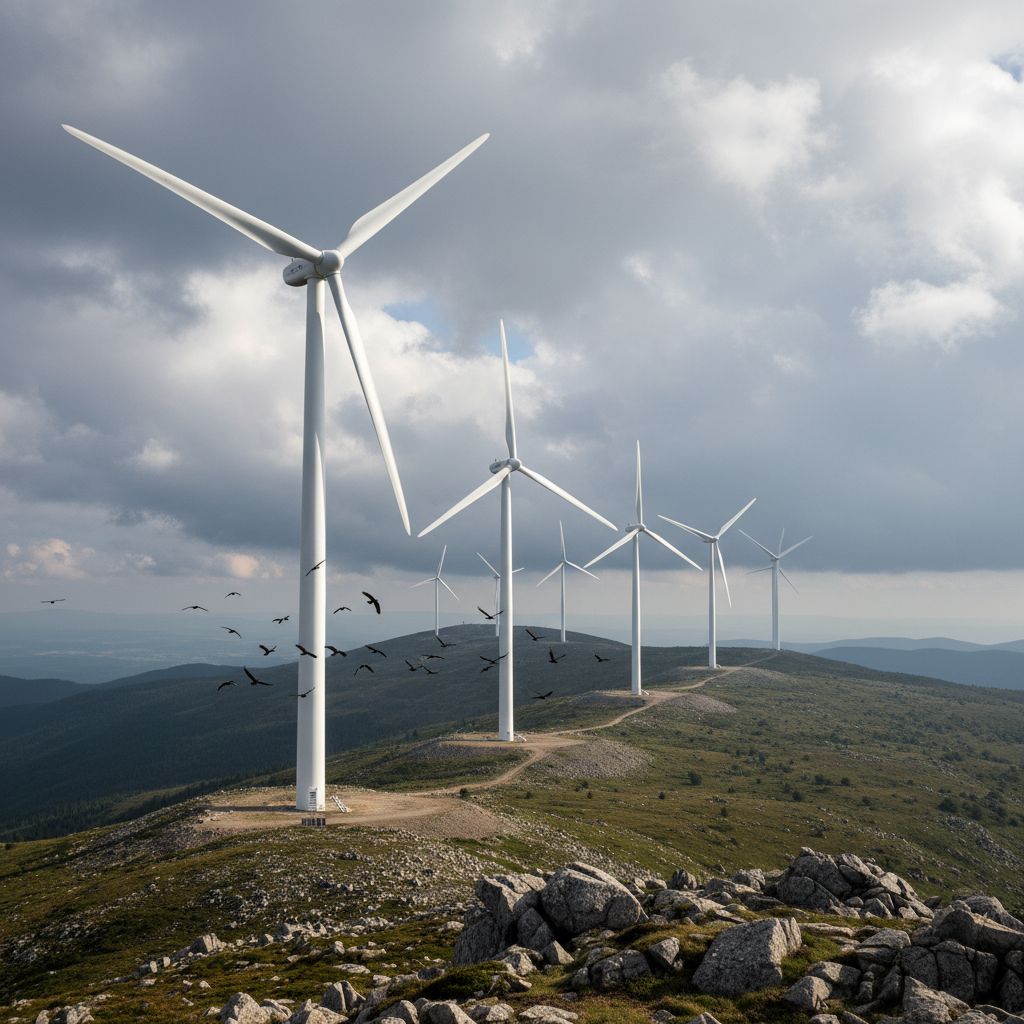
At a press conference this month intended to cover the European Union’s trade deal with Britain, former US president Donald Trump, as is his wont, veered into another topic: wind turbines. “Look, windmills are a con job,” he said. “Whales go crazy. Birds get killed. They kill people with their microchips, because they actually do use microchips.” The theatrical jabs are a staple of Trump’s rhetoric. But beyond his showmanship, the remarks are part of a long and global history of anti-renewable energy conspiracy theories.
Wind turbines are Trump’s favored example. He uses “windmills” as a colloquial, if technically incorrect, shorthand for the structures and often exaggerates or fabricates evidence about their harms. Conspiracy theories are not just about wind power, either. In the 1800s, there was a panic that telephones might spread leprosy or cancer. In the 1900s, asbestos was thought to pose few health risks but make money grow on trees. In both cases, as with windmills today, there was an element of people fearing new technology or losing control.
In other words, the thinking at the heart of Trump’s comments has been studied extensively. Once people accept it as true, evidence, fact-checking, and even expert reassurance are unlikely to change their minds.
For governments, companies, and organisations hoping to speed up the energy transition, this presents a major challenge. If high-visibility measures to increase clean energy are dogged by false and implacable opposition, then politicians may shy away from them, and they won’t be taken up by the private sector.
Wind Turbines Are Unsurprisingly Controversial
Climate scientists have known for decades that pumping excess carbon dioxide into the atmosphere would have severe consequences. In the 1950s, researchers established that emissions could lead to long-term and relatively imminent changes in the environment. However, they were not the first to advocate for an energy transition.
One influential theory suggests that early renewables lobbyists and governments intentionally framed the issue as a battle against “Big Oil,” with the fossil fuel industry opposing them and working to slow the growth of wind and solar. In many respects, this is precisely what happened. In 2004, the Australian government formed the Low Emissions Technology Advisory Group, a group of fossil fuel executives led by then–prime minister John Howard. While the group was ostensibly focused on decarbonization, its true aim was to maintain the existing dominance of coal, oil, and gas.
The industry’s view of wind power was similarly antagonistic. Since the 1970s, it has focused on the hidden nature of its products. Coal mines and oil wells tend to be far from residential areas. Nuclear plants are usually at high elevations and have access roads. Wind turbines, by contrast, are visible from afar and so are often built on ridgelines or otherwise open land. In a 2016 documentary about the group’s efforts to slow the growth of renewables, former BP CEO John Browne says, “If people can’t see an oilfield, that’s fine. But when they can see a wind turbine, then you’ve got a problem.”
Wind turbines were also particularly effective recruiting symbols for conspiracy theorists, who added their own myths and falsehoods to the public debate, such as the idea of “wind turbine syndrome.” The proposed condition, dismissed by the medical community as a “non-disease,” includes an array of unfounded effects of wind turbines on the human body.
In recent years, several academic studies have found similar results. In 2015, Kevin Winter and his colleagues analysed a representative German sample for a range of factors correlated with opposition to wind turbines. While age, education level, gender, and party affiliation had an impact, conspiracy thinking had a far greater effect. A later 2018 paper used a similar methodology for samples from the US, UK, and Australia. The study also confirmed that opposition to wind power was a common thread uniting many different conspiracy theories, whether about climate change denial, the alleged risks of renewable energy, or national energy security.
Opposition rooted in conspiracy theories and worldviews is rarely shifted by fact-checking. Someone who is convinced that wind turbines poison groundwater or cause blackouts is unlikely to be swayed by data or peer-reviewed studies demonstrating that, in fact, this is not the case.
Wind turbines, by their nature, are big and visible, making them an easy symbol of a fraught topic. In some, they are emblems of progress, of innovation, of climate action, and hope. In others, they are the mark of government interference, or loss of power, of unwanted change.
Behind this immediate debate is a deeper one about cultural identity. The fossil fuel era has powered a generation of growth and economic prosperity, and for some, the desire to accept that comes with environmental consequences is an affront to the past. This kind of refusal to acknowledge the negative side effects of technological change is known by scholars as “anti-reflexivity.” Trump, in his frequent nostalgia for an age of coal, oil, and gas, falls into this category.
Windmills as a focus of conspiracy theorists is, in many ways, an issue of identity politics as well. Male online communities such as the “manosphere” have treated climate change and action on it as a feminizing issue, unbecoming to “real men.” For many boomers, particularly white heterosexual men, the energy transition represents a shift in a world that once felt like theirs for the taking. Renewables, in this way, are not just technological or economic but also about culture and power.
In this context, Trump’s comments about “windmills” are likely to find an appreciative audience among those who see the transition as a threat rather than an opportunity. The colourful metaphors—his attacks on whales, birds, and the fanciful mention of microchips—are more clickbait than serious argument. But below that is a more insidious reality: conspiracy thinking about wind turbines is not about the wind turbines.