- calendar_today August 20, 2025
.
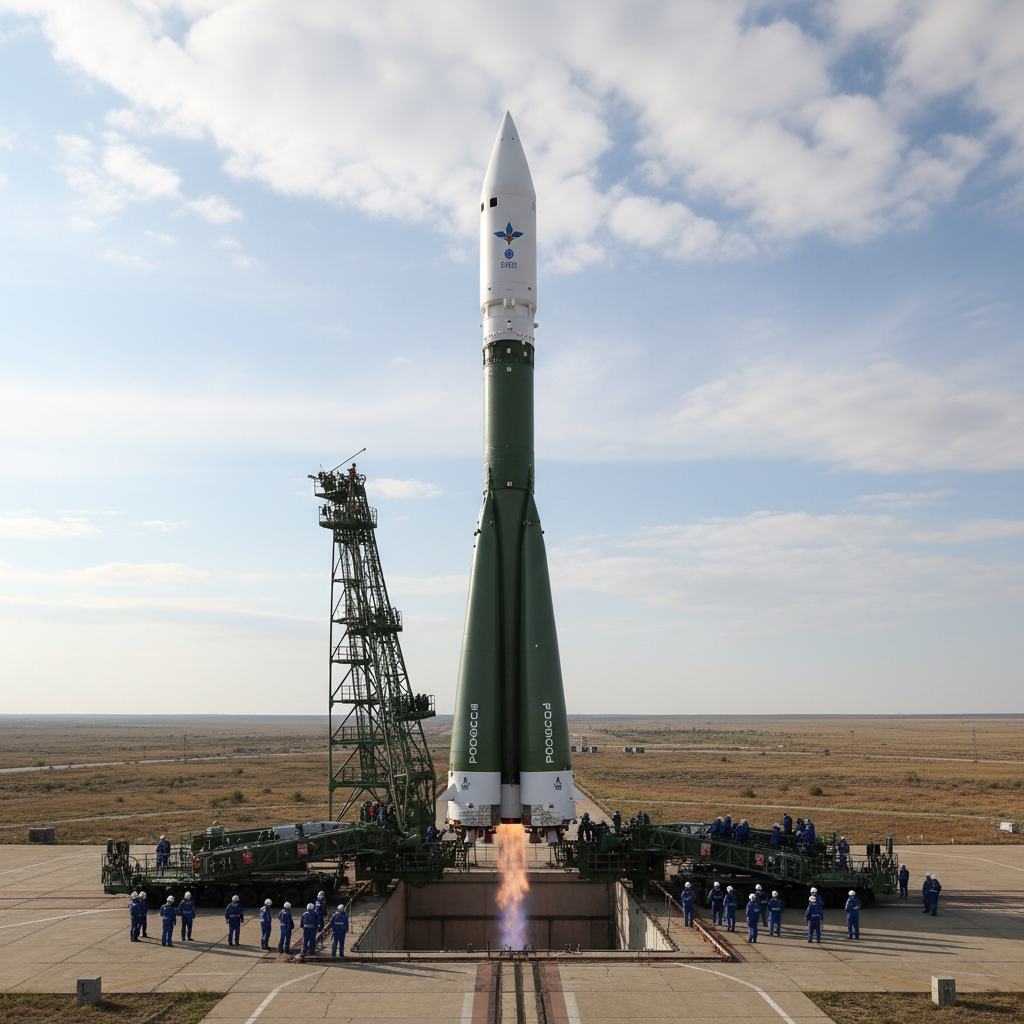
Russia is planning to fly its latest rocket, Soyuz-5, before the end of this year. Dmitry Bakanov, the director general of Roscosmos, Russia’s space agency, told state media TASS in an interview on Wednesday that December is the likely target for the first launch of the new rocket, with preparations at the Baikonur spaceport in Kazakhstan all but complete.
If the test is successful, it will mark the maiden flight of a rocket that’s been in development for more than a decade. Roscosmos has flagged several demonstration launches, but a fully operational service isn’t expected until 2028.
The Soyuz-5 (also known as Irtysh) is not so much a completely new concept. It instead takes much of its design from the Zenit-2 rocket, which was introduced in the 1980s by Ukraine’s Yuzhnoye Design Bureau. Zenit rockets were assembled in Ukraine, but used Russian-made RD-171 engines. That made Zenit, for many years, one of the only examples of Russian-Ukrainian aerospace collaboration in the post-Soviet space. That cooperation, of course, came to an end with Russia’s invasion of Ukraine in 2022. In late 2023, Russian forces even destroyed the Ukrainian production facility where Zenit rockets had previously been assembled.
Soyuz-5 is a larger version of Zenit that is built entirely in Russia. The reworked design is the result of an effort to eliminate Ukrainian components from Russia’s launch systems. By building a domestic replacement for Zenit, Moscow gains a major advantage over reliance on a technology that the Russian government itself labeled a “necessary evil.” At the same time, Soyuz-5 is also meant to replace Russia’s most venerable rocket, the Proton-M, which dates back to the 1960s.
A Bridge Between Past and Future
By comparison to SpaceX’s Falcon Heavy, Soyuz-5 is in the medium-lift class of launch vehicles. Roscosmos has stated that the rocket can deliver some 17 metric tons to low-Earth orbit. That’s possible, in part, thanks to larger propellant tanks when compared to Zenit. The engine at its heart, the RD-171MV, is the latest in a long line of engines that can be traced back to the Energia program of the 1980s.
Energia was the rocket that powered the Soviet Union’s short-lived space shuttle, Buran. The most important change to RD-171MV, compared to the engines used in Zenit, is that they make no use of Ukrainian parts. Burning kerosene and liquid oxygen, it produces more than three times the thrust of NASA’s Space Shuttle main engine, and it’s the most powerful liquid-fueled rocket engine currently in use.
As an expendable rocket, Soyuz-5 also represents something of an anachronism. Newer launch vehicles, most prominently SpaceX’s Falcon 9, have been designed from the ground up to be reusable. Whether Soyuz-5 can therefore gain any significant share of the international market is in doubt.
For Roscosmos, however, the rocket has a key bridging role. Constrained by both sanctions and its own war expenses, Russia has struggled to develop a new, reusable rocket from scratch. The Amur project, which at one time was known as Soyuz-7, was designed with that in mind. With a reusable first stage and methane-fueled engines, Amur was seen as the rocket that would eventually allow Russia to compete with SpaceX on price. The problem, however, has been delays. A launch of Amur-1, a small reusable demonstrator, has been pushed back to 2025, and a first full-scale launch isn’t now expected until at least 2030.
Soyuz-5, meanwhile, at least temporarily fills the gap. By keeping the Russian space program on track for the next few years, even if it’s doing so with technology from the Soviet past.
The commercial prospects, however, remain cloudy. Over the last decade, the global launch industry has been reshaped by cheaper, more flexible offerings from SpaceX and Chinese providers. Russia continues to use its Soyuz-2 rocket for crewed launches and the Angara family for larger payloads, but neither has found a strong niche in the international market. Soyuz-5 will have to buck that trend, and it’s not clear yet whether the new rocket can do so.
Still, the fact that Roscosmos has been able to get Soyuz-5 to the point of launch in such a challenging time is a success story in itself. A successful flight in December would show that, sanctions and a smaller budget be damned, Russia can still get new hardware to the launch pad.
Soyuz-5 is not a game-changer in rocket design. For Russia, however, it is a political and industrial symbol. It is one small step in Moscow’s quest to end its reliance on foreign technology. It is also a bridge to the future, whether that future is built with Amur or some other new generation of launch vehicles.